Deception is one thing that’s common among all cyberattacks, and spoofing an IP address is one such method that attackers have used for a long time now. It involves using a false source address to disguise the source of internet traffic. The results of such an act are grave.
Here is a guide on what IP spoofing entails, how it is done, its attack vectors, and more importantly, how you can handle it.
What is IP spoofing?

IP spoofing refers to the manipulation of the source IP address found in a packet of information. Instead of disclosing their own network identity, the attacker alters the packet header, particularly the “source IP” entry, to mask themselves as some other computer system.
You can think of it like posting a message addressed to someone and using someone else’s name as your return address. This makes the recipient think that it comes from a trusted sender and receives it accordingly.
The reason why IP spoofing works is because of one major weakness in the Internet Protocol system. Normally, there is no way to authenticate the source IP address of the sender of a packet of information.
As long as the source address is not checked out, the attack can easily penetrate networks, introduce new packets into ongoing communication, trick security mechanisms, and reroute traffic.
IP spoofing is not an individual attack itself. Rather, attackers use it to perform actions, including data theft, packet sniffing, spreading malware, session hijacking, man-in-the-middle attacks, and to carry out denial-of-service attacks on scale. IP spoofing is relatively easy to implement, but very difficult to track.
What is address spoofing?
Address spoofing and IP spoofing are often related, but they are different. While both denote the same basic idea, address spoofing is the act of tampering with source address details in networking, while IP spoofing is the most prevalent form. For a deeper look at all types of spoofing, from email to DNS, explore our detailed guide on what spoofing is and how it works.
However, the term “address spoofing” may sometimes include:
| Type | What gets faked | Scope |
|---|---|---|
| IP spoofing | Source IP address in packet header | Remote networks and systems |
| MAC address spoofing | Hardware identifier on a device | Local network (LAN) |
| ARP spoofing | IP -to- MAC mapping on a local network | LAN |
| Email address spoofing | Sender address in email header | Email communications |
| DNS spoofing | DNS records redirecting to fake sites | Network-wide |
All employ the same principle, impersonating an authority to slip past security controls.
How does IP spoofing work?
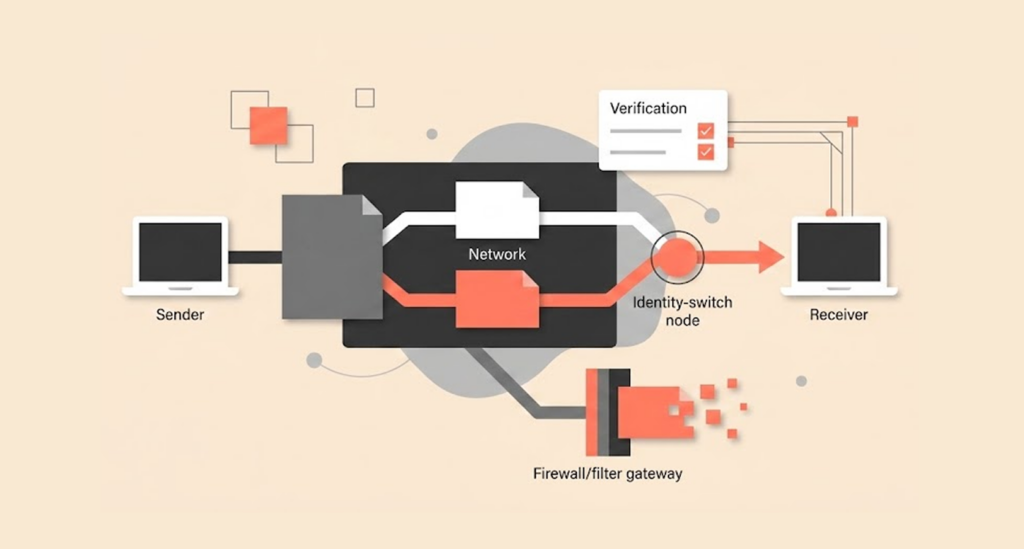
Each time you connect online, your device sends data packets. These packets have a header which has two main elements, the source IP and destination IP.
The server uses this header to send its answer. Normally, all of this occurs through the TCP/IP protocol; it includes handshaking between the devices to ensure they are ready.
So, here is how an IP spoofing attack looks like:
Step 1: Normal handshaking starts
When two devices establish a connection there is a three-way handshake. The first device sends a synchronized (SYN for short) message. The second responds with SYN-ACK. Finally, there is ACK from the first device. The device establishes the connection.
Step 2: The attacker creates fake packets
Instead of following the normal procedure, the attacker creates packets using the source IP, which belongs to another device.
Step 3: The fake packets arrive at the destination server
The receiving server takes these packets as legitimate and cannot detect that these packets belong to another device because most systems do not check whether the source IP actually belongs to the sender.
Step 4: The attack remains unseen
When the server replies, the responses go to the fake (spoofed) IP, not the attacker’s real address. That’s the trick; it lets attackers stay invisible while they flood a server with traffic, look for vulnerabilities, or set up deeper access.
Step 5: The main attack itself takes place
Depending on the attacker’s motive, the attack may take different routes. Either the attacker sends overwhelming amounts of fake requests to the server, intercepts communication, or they pretend to be a trusted device to penetrate into the system.
Why does IP spoofing matter?
The need for understanding IP spoofing is important as it enables some of the worst cyberattacks carried out online. Some of its effects include circumvention of network security mechanisms, conducting distributed denial of service (DDoS) attacks that disrupt normal business operations, and making it easy for bad actors to obtain credentials and sensitive information without being detected.
Though the idea of spoofing might sound simple enough, the level of damage it creates is very high. IP spoofing is more common than you think.
According to the CAIDA Spoofer Project, approximately 25% of the autonomous systems and network blocks it has surveyed still permit IP spoofing. This is due to incomplete deployment of Source Address Validation (SAV), so businesses should take serious measures to prevent it.
Why do hackers use IP spoofing?

IP spoofing is not a mere academic topic but rather a real threat that poses a danger for network interruptions, data theft, and other kinds of security breaches that can result in huge financial losses for businesses. Here’s why hackers use it:
Firewall bypass
Attackers use this technique to slip past authentication measures that rely on IP-based trust. Attackers use trusted IP addresses to blend in and evade security tools.
So it lets them move around the network freely, planting backdoors, stealing data, and whatever else they’re there for without anyone finding out.
To conduct interception attacks
For instance, in a man-in-the-middle (MITM) attack, spoofed addresses allow hackers to impersonate a trustworthy party, intercept data sent between two parties and direct victims to malicious sites without being noticed by them. Email spoofing is another common impersonation technique; our detailed guide on this covers what it is, its dangers, and how to protect yourself.
Anonymity
By spoofing the source IP address, an attacker can successfully hide the virtual location. The attack makes it extremely difficult for defenders to trace the attacker’s real location, even after causing damage.
Testing defenses at less risk
Some attackers may send spoofed traffic as a method of testing the defenses of the network rather than causing harm. Attackers make spoofed traffic appear legitimate, so security tools rarely detect it.
Amplifying attack power
Fake/spoofed requests force third party servers to send their responses to the victim, increasing traffic without the attacker having to use as much resources as they would have needed to.
Types of IP spoofing attacks
It helps to take a look at the various ways in which IP spoofing may be used to appreciate its versatility and potential. Here are some common IP spoofing attacks, with an explanation of each one. While IP spoofing focuses on network deception, location spoofing targets GPS data, for those interested in changing their device’s location, there are dedicated GPS spoofing apps for Android and iOS.
| Attack type | How IP spoofing is used | Primary goal |
|---|---|---|
| Blind spoofing | Forged packets sent without seeing responses | Server flooding, network probing |
| Non-blind spoofing | Attacker monitors target responses | Session hijacking, data injection |
| DDoS amplification | Victim’s IP spoofed; third-party servers reply to victim | Overwhelm target with traffic |
| MITM attack | Attacker impersonates both communicating parties | Intercept or alter traffic |
| Session hijacking | Spoofed IP used to take over an active session | Steal tokens, impersonate users |
| Botnet masking | Spoofing hides real identity of botnet nodes | Evade detection and takedowns |
| Hybrid (IP + DNS) | IP spoofing combined with DNS record manipulation | Redirect users to fake sites |
Let’s understand at each one of these below:
Blind spoofing
This involves the attacker sending packets to a victim without seeing the response packets. They will need to guess the connection parameters, including the sequence number. However, even though it requires less precision, it may be employed for purposes such as flooding a server and/or testing systems without giving away one’s location.
Non-blind spoofing
This type of spoofing allows the attacker to actually observe the responses from the target system. Because of this, he can inject and modify data packets with much greater accuracy. This makes non-blind spoofing a difficult task to perform, but a very dangerous one.
Spoofed IP address in DDoS attacks
This is probably the most common application of IP spoofing. The attacker sends requests in bulk using an incorrect IP source address; usually the one of the attacked website. In response, the amplifying server bombards the victim’s system with replies.
There are several popular vectors of amplification attacks, among them incorrectly configured DNS and NTP services providing a very high ratio of reply-to-query response size. As a result, one attacker is capable of using thousands of third-party servers without the server operators’ consent.
One good example of DDoS, is the attack on GitHub in 2018 pulled by exploiting misconfigured Memcached servers using spoofed packets. It hit a peak of 1.35 Tbps and caused GitHub to go offline for 10 minutes.
MITM attacks
With a man in the middle attack, an attacker positions themselves between two the sender and recipient pretending to be both using a spoofed IP address. Each party thinks they’re talking directly to the other.
This way, the attacker is able to read, relay, and even modify the traffic in transit visibly. Attackers can carry out these attacks more easily when connections lack encryption or when they target local networks (LANs). They often combine them with ARP or DNS spoofing.
Hijacking and impersonation
In session hijacking, the attacker’s aim is to gain control over an established connection and he does this by spoofing packet headers. After gaining entry into the network, the attacker then issues commands, steals the authentication tokens or pretends to be the rightful user so as to enter the network even further.
Networks with weak security where session data is unencrypted are the most susceptible to this kind of attack.
Botnet masking
To mask the true identity of each bot in a network that they control, the botnet owners will spoof the IP addresses. This approach makes it extremely difficult for security teams to detect botnets used for DDoS attacks, cryptojacking, and spying.
Hybrid spoofing (IP + DNS)
There are cases when an attack includes not only IP spoofing but also DNS spoofing. Through such a technique, the attackers can redirect users to spoofed web pages and do whatever they want. This includes, from stealing credentials to spreading malware.
IP spoofing in network security: Real-world examples
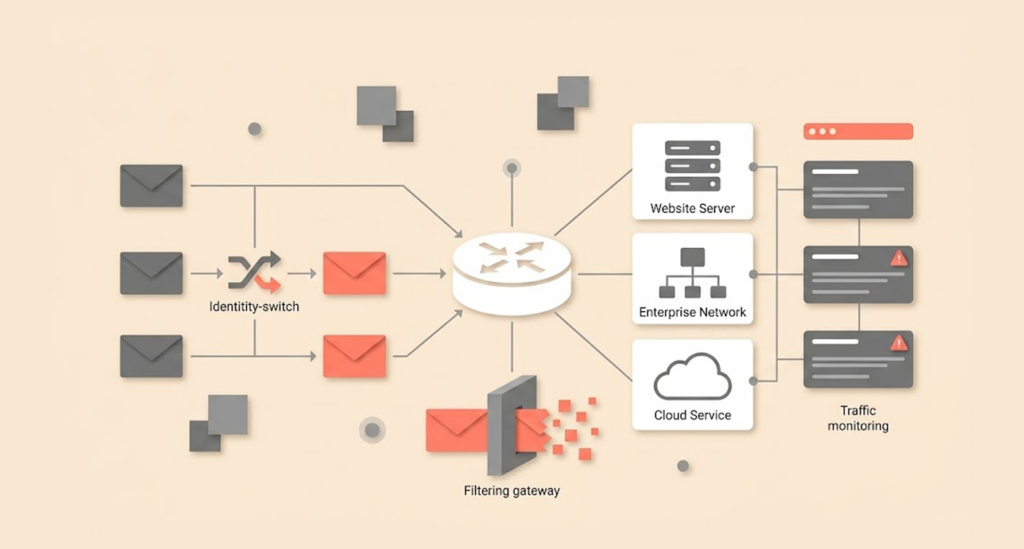
IP spoofing isn’t some textbook concept; it actually happens in real life and can have serious consequences. Below, we are going to discuss some examples that can explain how dangerous it can be for network security:
Incident in 2018
In this incident, attackers used spoofing to fake IP addresses of legitimate GitHub and amplified the attack through Memcached servers. For some time, GitHub received 1.35 Tbps of attacks, which was 50 times faster than its usual server response rate.
The fast bombarding of traffic disabled the platform for a good 10 minutes. GitHub itself publicly documented this attack, and it’s still one of the biggest DDoS attacks in history.
Google incident in 2020
Here, some Chinese criminals used UDP amplification and IP spoofing to direct 2.54 Tbps of attack traffic to the infrastructure of Google. It exceeded almost four times the previous record. Google revealed this information in its Threat Analysis Report. Attackers distributed this attack across several thousand ISPs.
Other noteworthy IP spoofing attacks include AWS Shield 2.3 Tbps DDoS that happened back in 2020. And also the Meris botnet that trended between 2021 and 2022. Some recent examples include the hyper-attack that reached 7.3 Tbps which Cloudflare eventually blocked and the 6.3 Tbps attack on KrebsOnSecurity. Both of these happened in 2025.
What is important in both cases is the scale of the attacks. Attackers used IP spoofing to amplify the traffic. Thus, it tricked third-party servers and they were able to carry out the attacks without their knowledge.
What are the risks of IP spoofing attacks
An IP spoofing attack, if successful, can have serious impacts. These include the followings:
- Loss of finances: Attackers can redirect your transactions, steal credentials, and can even carry out fraudulent operations that can cause monetary losses to an organization.
- Unauthorized access to accounts: Attackers impersonate authorized devices to gain unauthorized access to the network. This is usually just a part of a bigger intrusion into a company’s computer system.
- Disruption of services: These attacks can also shut down or make the service unavailable for minutes or hours. This step alone can bring significant financial losses and damage to your company’s reputation.
- Data interception: In MITM attacks, attackers can monitor or manipulate communications that may contain confidential user or enterprise data. If attackers steal sensitive information during a security breach, they may also share or sell it online. Knowing what to do if your data ends up on the dark web can help you secure your accounts and limit further damage.
- Reputation damage: When the company’s infrastructure is being used to perform IP spoofing attacks against other companies, it faces the risk of being blocklisted by security firms or losing its clients’ and partners’ trust.
How to detect IP spoofing
IP spoofing detection is not easy. Spoofed traffic looks like normal network activity from the outside, so users remain unaware of the threat unless the attack causes a noticeable disruption.
Detection techniques include:
| Detection method | How it works | Best for |
|---|---|---|
| Ingress/egress filtering | Checks packet source addresses against expected ranges at network boundaries | Catching mismatched or impossible source IPs |
| Deep packet inspection (DPI) | Examines packet headers in real time for abnormal values or missing auth data | Real-time detection of forged headers |
| Hop-count verification | Compares the number of network hops against what’s expected from a genuine source | Flagging packets that didn’t travel the expected route |
| Reverse Path Forwarding (RPF) | Traces the route from the source address back to verify legitimacy | Blocking packets with no valid return path |
| Log and traffic analysis | Compares inbound/outbound patterns to reveal inconsistencies | Post-incident investigation and pattern detection |
| Anomaly detection / IDS | Automated systems flag irregular traffic spikes typical of spoofing-based DDoS | Volume-based attack detection |
| TCP sequence analysis | Checks whether packet sequences match what the server generated | Catching blind spoofing attempts |
Some of the most common tools for IP spoofing detection include Snort (IDS software), Wireshark (packet capture software), Zeek (network security monitoring software), and Cloudflare and AWS Shield, which have in-built protections against DDoS attacks and IP spoofing.
How to prevent IP spoofing

You can never avoid IP spoofing completely. Hackers will always find their way. Still, if you stack your defenses smart and put some layered protection in place, you can make it way tougher for them to pull it off. You won’t eliminate the risk, but you can keep it down to a manageable level. Prevention methods are different for an IT administrator and a user.
Preventing IP spoofing for IT and network administrators
1. Ingress/egress Filtering (BCP38)
This is an essential layer of defense against spoofing attacks. First, verify everything to make sure that incoming packets do not have any spoofed internal IPs, and outgoing packets have valid source IPs. The IETF’s BCP38 standard lays out a solid anti-spoofing method. Every network admin should use it.
2. Access Control Lists (ACLs)
ACLs are your next tool. With ACLs, you control exactly which IP ranges can cross your network’s borders. You can shut down unnecessary communication between specific hosts or networks. The result? Fewer spoofed addresses slipping through to your sensitive systems.
3. Deep Packet Inspection (DPI) & uRPF checks
DPI verifies packet headers in real-time. Checks for uRPF guarantee that all packets arriving at the destination IP have a valid path back on the same interface and help to detect inconsistencies that suggest spoofing.
4. Rate limiting and real-time traffic monitoring
Rate limiting guarantees that none of the sources flood the network with requests. Together with real-time traffic analysis, this can help detect the sharp spikes in the network traffic associated with a DDoS attack done using spoofing before it unfolds fully.
5. Keep software and firmware updated
Outdated router firmware is an open door for attackers, especially with spoofing tricks. And updates are among the best and easiest ways to patch that hole, yet lots of admins overlook it. Don’t be one of them; keep your routers, firewalls, and internet-facing software current and patched.
6. Apply Network Access Controls (NACs)
Network Access Control determines which devices can access the network in the first place. The Device Posture Check process inspects every device that tries to connect, and prevents access by non-compliant devices.
Preventing IP spoofing in firewall configurations
A well-configured firewall would be your greatest resource. A packet-filtering firewall compares packet headers with the access control list and blocks everything else.
- Ingress filtering: Blocks packets entering from an external source claiming that their source IP belongs to an internal address range.
- Egress filtering: It detects packets that use source IP addresses from ranges outside your network.
By implementing ingress and egress filtering in addition to deep packet inspection (DPI) along with an intrusion detection system (IDS), you will create a layered defense which is much harder to bypass compared to using one security measure alone.
IP Spoofing prevention checklist for IT teams
- BCP38 ingress and egress filtering configured
- ACLs implemented on all important network segments
- DPI and uRPF enabled on border routers
- IDS (e.g. Snort, Zeek) installed and configured
- Rate limiting configured on network perimeter
- Router and firewall firmware updated
- NAC and Device Posture Check activated
IP spoofing prevention tips for individual users
Use NordVPN
We recommend NordVPN as your best choice when it comes to private internet protection. With NordVPN, your internet traffic gets encrypted, and your IP address gets masked, so no one will be able to intercept and manipulate your data. For those who want more granular control over location data in their browser, there are ways to change your location settings directly in Chrome.
NordVPN’s Threat Protection Pro feature provides additional protection by blocking suspicious sites that might be trying to use MITM attack with IP spoofing to get access to your device.
Access only HTTPS websites
HTTPS provides an extra layer of defense by encrypting your web traffic, making it more challenging for MITM attackers to intercept or tamper with your traffic, even if they’re able to spoof their way into your connection.
Turn on multi-factor authentication
In case your account session is stolen due to the spoofing attack, it will be difficult to assume control over your account if it has MFA enabled. This security measure can be considered as one of the easiest and most important measures that anyone can consider implementing.
Consider using IPv6 if you’re a network administrator
IPv6 helps, too. Its packet validation is stronger than what you get with IPv4. Spoofing source addresses in IPv6 environments is more challenging for attackers. Though it’ll not 100% remove the risk of spoofing, it just raises the bar higher making your infrastructure a tougher target.
Is IP spoofing illegal?
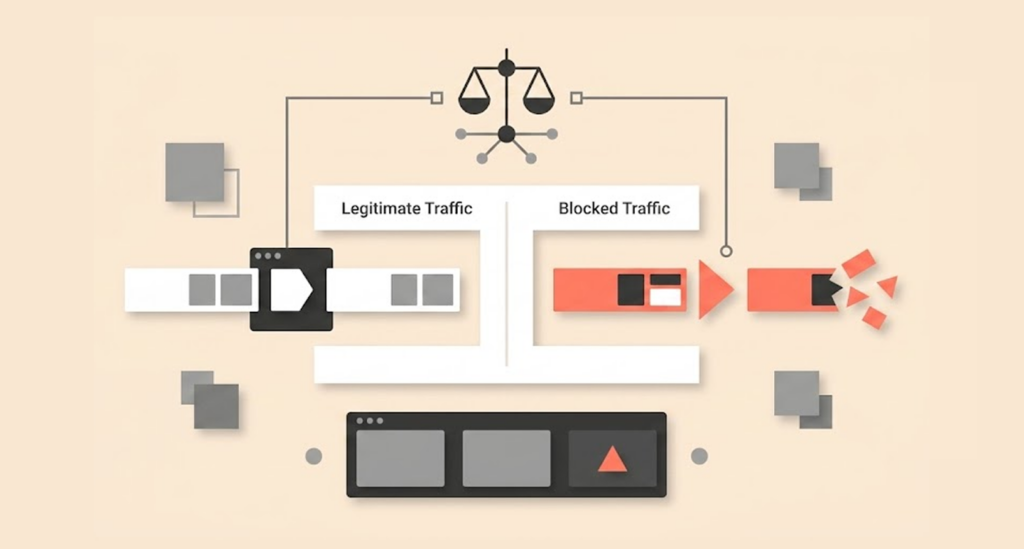
IP spoofing is not an illegal activity, rather whether it’s legal or not depends on intent and authorization.
Spoofing isn’t something only hackers do; it’s actually a tool that security analysts and network admins use a lot. They lean on it to test how tough a network really is against DDoS attacks, or during legit penetration tests. The same thing is applicable when routing your traffic through a VPN like NordVPN, which lets you hide your real identity online and stay anonymous. This is perfectly legal.
However, if it’s used in any way to carry out theft of information, launching a DDoS attack, unauthorized access, or online impersonation, then it becomes a criminal offense punishable under cybercrime laws in many regions. In the US, the CFAA (Computer Fraud & Abuse Act) will come into effect.
In the European Union, the NIS2 directive, along with individual countries’ cybercrime laws, governs the activity. To sum up, IP spoofing for testing and privacy purposes is legal. But IP spoofing for any kind of criminal activity is a crime.
FAQs
The most popular example of such an attack is DDoS amplification attack. Attackers make their packets look like they come from the IP of the victim, which results in amplified traffic being delivered straight to the victim.
Popular types include DDoS amplification attack, man-in-the-middle attack, session hijacking, botnet masking, and hybrid attack that uses IP spoofing together with DNS spoofing.
Tracing spoofed IPs is very difficult because forged packets often appear to come from legitimate IP addresses. Investigators use indirect methods, such as they check traffic patterns, logs, timestamps, and also coordinate with ISPs to try and trace it back to the original source.
ARP spoofing (also referred to as ARP poisoning) occurs when a hacker sends out fake messages within a LAN, tricking devices within the network into associating their own IP address with the MAC address of the hacker, enabling him to intercept, manipulate, and block network traffic. IP spoofing allows users to spoof a source IP in data packets sent to other systems or wider networks, and is commonly used to gain access to remote systems.
IP hijacking is like stealing someone’s identity entirely. The attacker takes over control of an IP address and then redirects traffic meant for someone else to their own setup, but spoofing is just falsifying an IP address in a data packet.
Internationally, spoofing has been used in many types of cyberattacks, including the ever growing DDoS attacks. Even though more recent systems provide more security against such activities, spoofing is still the most effective means of accessing a victim whose systems lack adequate filter, control, and encryption.
While they both involve IPs, they’re two different things entirely. A VPN uses encryption to hide your traffic and then routes it through a secure server, ultimately swapping your real IP address with that server’s IP to make your connection private and secure. On the contrary, IP spoofing uses forged packet headers to impersonate another source IP address. A VPN is an entirely legitimate privacy tool while IP spoofing can be used for hacking.