Snapchat scams are very common these days, with scammers targeting millions daily. According to the FCT’s report, social media platforms like Snapchat are the most popular ways scammers reach victims.
Criminals use different kinds of tactics, such as impersonating people using fake accounts to get personal details from other users. Sometimes they blackmail to make them pay money or even use phishing texts to deceive people into giving away access to their accounts. The most dangerous scam right now is Snapchat scammer blackmail, also called sextortion.
This guide covers all 13 active scams on Snapchat, and their warning signs. You’ll also learn how to identify a fake Snapchat account, and exactly what to do if you’ve already been targeted.
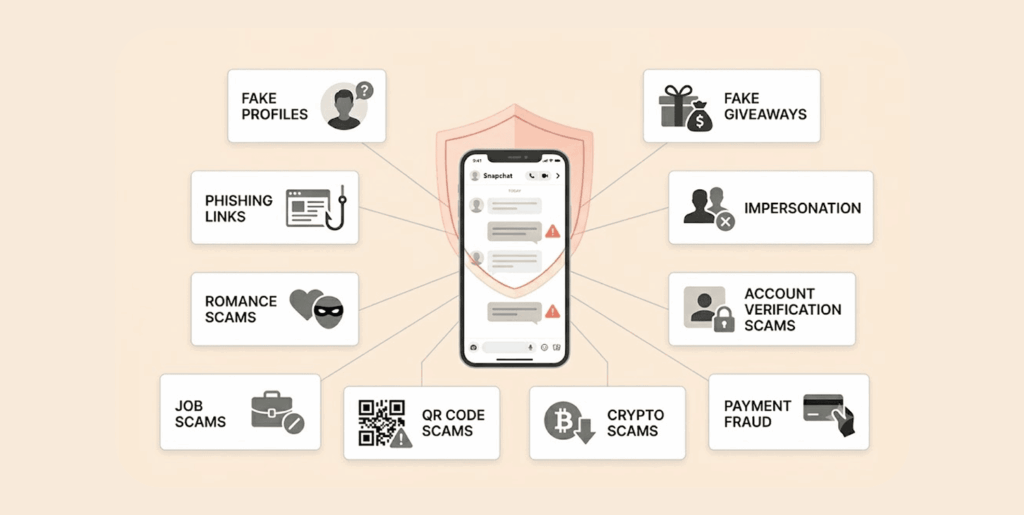
Top Snapchat scams – Quick list
- Romance scams: Scammer fakes a love interest, builds trust, and then asks for money.
- Phishing scam: You get a fake Snapchat support message that’s designed to trick you into giving away your login details.
- Friend account recovery scam: Con artists pretend to be your friend and trick you into giving them a verification code.
- Sugar daddy or sugar mommy scams: They’d promise that they’ll support you financially; instead, they will take your money.
- Premium account scams & Blackmail: Someones create fake offers for premium content and then blackmails you.
- Meetup or hookup scams: Scammers say they want to meet up, yet always require that you pay them in advance.
- Fake money-making/investment schemes: These include fake get-rich-quick video schemes to entice you into providing them with either your money or credentials.
- Fake survey scams: Surveys that are designed to collect sensitive information or introduce malware onto your computer.
- Job Scams: Someone falsely advertises high-paying jobs that will charge you an advance fee for your employment or a pyramid scheme.
- Imposter scams: Scammers impersonate people you trust or know to get you to send them money or share personal information.
- Fake contest scam: Contests where you receive a notification that you have “won” but have to pay to receive your prize.
- Fake product scam: They try to sell expensive designer or name-brand merchandise to you at extremely low prices and then do not deliver.
- Catfishing: Criminals use someone else’s identity in order to establish a false relationship with you, usually for financial gain.
What are Snapchat scams?
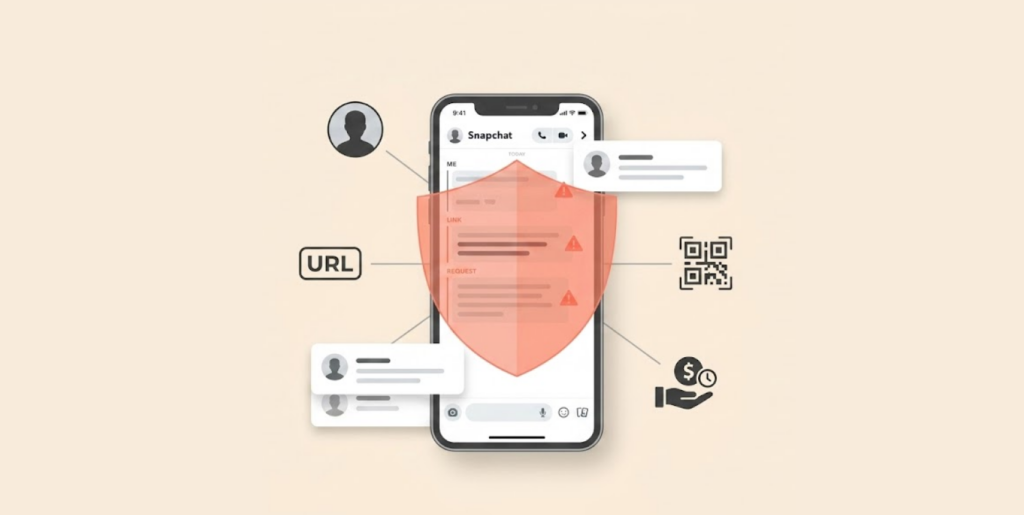
These are basically fraudulent schemes where someone tricks users into handing over money, personal information, or their Snapchat account access. Scammers take advantage of the platform’s casual style of communication, plus the fact that most of the users are young and don’t often catch on to shady behavior quickly. And those disappearing messages provide a perfect cover for anyone up to no good.
Some types of scams include fake investment opportunities, as well as directly blackmailing users for money. The fallout from these scams isn’t pretty. They steal people’s identities, users lose serious money, or victims suffer emotionally as well.
How do these Snapchat scams operate?
Most Snapchat scams follow this process:
- Setting up the scam: The scammer creates a fake account or logs into an existing account of a person posing as your friend, a celebrity, or a trusted business.
- Hook or bait you in: The scammer will contact you with a great offer, a sad story, or an “urgent” request to get you emotionally involved.
- The request: They will ask you for money, a verification code, your login information, or personal information.
- The payoff: Once they get what they want, they vanish like that embarrassing snap from last night. Sometimes they’ll lock you out of your own account, or they could even drain your bank account too.
The whole setup of Snapchat makes it more inviting to scammers. Messages vanish, and if you try to screenshot as evidence, it gets flagged. So, there’s little to no paper trail, which means these cyber thieves can disappear without any proof they were even there.
Most common Snapchat scams – Detailed list
1. Romance scams
In this type of scam, the scammer builds a fake romantic relationship by adopting someone else’s identity and taking on their image.
Romance scams are among the oldest scam tricks. But these days, the scammers have adopted more sophisticated ways around it. They’ll first create a fake profile that looks genuine and start messaging their target.
After several days or weeks, you start to believe an emotional connection has developed and that trust has been established. Then they will play their part; they will tell you about a medical emergency, a cell phone, or an airplane ticket to “finally meet in person.”
The Federal Trade Commission found that half of the reported losses from romance scams were due to initial contact on social media (Facebook, Instagram, Snapchat, etc), with victims collectively losing over $1.3 billion.
Signs of the scam
- Love statements or similar within a few days of meeting you
- Avoids video calls or makes up excuses as to why you cannot do it
- Each emergency needs money you send digitally to help them out
How do you protect yourself?
- Search their profile photo on Google Reverse Image Search before trusting them
- Make sure to do a live video call and see if it’s unscripted and not a pre-recorded video
- Don’t send money to someone you haven’t met
2. Phishing scams
Here, scammers pretend to be from actual Snapchat support, sliding into your DMs, texts, or emails with some links. They’d often send a message that sounds urgent. Something like “your account’s been compromised, click here to fix it.”
Their goal stays to put you in panic mode so you click the link, which then takes you to what looks like a Snapchat login page. It’ll look legit, but it’s a total fake. The second you type in your username and password, they capture your info.
Some common phrases used in Snapchat phishing scams are:
- “Your account will be deleted in 24 hours”
- “Immediate action required”
- “You’ve won, click here to verify”
- “Your friends list will be removed for inactivity”
Urgency is the primary reason why scammers succeed with phishing scams. They want you to take action before thinking about what you are doing.
How to prevent phishing scams
- Snapchat will never send you a notice via random DMs or any other email address; it’s always from a @snapchat.com email address. So double-check who’s sending the message before clicking anything.
- Never click random login or recovery links that drop in your inbox. Stick to the official app always if you need to recover your account.
- Run every suspicious link through tools like VirusTotal first and make sure they’re safe.
3. Friend account recovery scams
This is one of those scams that catches many people off guard. You get a message from someone pretending to be your “friend.” They say their account is locked and they’re trying to recover it.
Then asks you to share a 6-digit code Snapchat just texted to you. That code isn’t to help a friend; it’s actually a way for the scammer to hijack your account. Give it to them, and they’re in while you’re locked out.
How to avoid this scam?
- Never share a verification code with anyone asking for it, even if it’s urgent.
- Call or text your actual friend, maybe through another app, and ask them if they are the one requesting the code.
- Double-check all requests that come in your DM before you make a move. If you feel a message sounds suspicious, the zest is to ignore it.
4. Sugar Daddy/Mommy scams
A scammer is pretending to be an older, rich person who will give you financial support, but has you sent him money or your financial information using a fake payment scheme.
In these scams, typically younger users are promised an allowance each week in exchange for a companion, and like all scams, there is always a catch (e.g., “You must pay $XX to verify your account,” or “You must first wire money back to me because I sent you a false large payment”).
These often happen through using a stolen credit card or fake check to send you the large payment, and after several days of you following their instructions to wire back part of the money, your bank would reverse the original large payment, thus leaving you with the full amount owed (in a real case in California few years ago, a teen ended up in thousands of dollars in debt to their bank because of this type of scam).
How to protect yourself from this scam
- Block anyone who contacts you out of the blue, wanting to help you financially.
- Never give anyone your banking information or send them money to “prove your commitment” to them.
- Wait at least 30 days to touch on any unexpected payments. If it was sent with a stolen card, the bank will automatically reverse it.
5. Premium account scams & Blackmail
In this kind of scam, a scammer will claim to provide you with paid adult content (which Snapchat never offers). Then the scammer collects your money and blackmails you with pictures or information you have shared with them.
There is no such premium subscription for Snapchat. This is not something that the platform has ever offered to its users. If someone is requesting payments through Venmo, Cash App, etc., for “exclusive” content, know that you are being scammed.
This is also a gateway to a more serious crime called sextortion (blackmail). Once someone has shared a personal photo, the scammer threatens to send the picture to friends and family members unless he/she/they receive payment. Once you pay, you signal to the scammer that you will likely pay again.
Teenagers are the most targeted demographic for this type of scam. For example, according to KCUR reporting, there were multiple examples of students from the University of Missouri being extorted by scammers using this method on Snapchat.
Preventative measures
- Never pay for content on Snapchat; there is no such legitimate content
- Do not pay if you are being blackmailed. Contact the website’s Trust and Safety Team, and also report to your local police department.
- If the person is a minor, report immediately to NCMEC’s CyberTipline.
6. Meetup or hook-up scams
Scammers build up interest to meet in person, but would often fabricate financial barriers, wanting you to send them money first so they can meet up. Examples of common excuses they use would include “the car broke down,” “the ticket was too expensive,” or “I had an emergency.” Each time you attempt to meet with the scammer to provide support, they will generate additional reasons that will require you to send more money.
These scams play off the hope that you feel that this person is legitimate; this is exactly what some scammers depend upon.
To protect yourself
- Don’t ever send money to a person whom you have never met for transportation or logistical support.
- Use Ghost mode on Snap Map to hide your location from users.
- Always request a live (not a virtual) video call prior to agreeing to plans with someone you don’t know; real people won’t avoid this very often.
7. Fake money-making and investment scams
These types of scams take place when a scammer tries to persuade you to invest in a high-return investment or influencer opportunity via a direct message on Snapchat. After you engage, they will either steal your money or your account credentials.
For example, you may receive a message that says, “Send me $50, and I’ll help you make money off of a $5000 influencer deal“. Or, you may receive a message such as “I made $3000 last week and can show you how to do it too on this crypto platform.”
Another version of this scam that has been extremely effective is when a scammer offers consumers a “secret trading app” where they can see impressive, yet falsified, return on investment rates. The fake returns are big enough to convince the victim to invest more money. When the victim ultimately invests more money, the app disappears along with their funds.
Here are some ways to protect yourself
- If you receive any unsolicited financial opportunities via Snapchat, you can consider them to be scams with no exceptions.
- Legitimate investment platforms will have verifiable regulatory records, and you should check the SEC EDGAR database for any opportunities before investing.
- If you know someone who starts pitching an investment opportunity out of nowhere, you should verify through other channels whether or not their account has been hacked.
8. Fake survey scams
Fraudsters pose as your favorite brand or popular influencers and DM you a too-good-to-be-true survey. Something like: “Fill this out and win a $250 gift card!” If you click the survey link and it redirects you to a sketchy site that either infects you with malware or harvests your personal info.
The link often leads to a form asking for information like credit card numbers, passwords, Social Security numbers, stuff no proper survey would ever even request.
If you spot any “Snap Surveys Inc.,” don’t buy it. Note that there’s an actual research company called Snap Surveys, but they have zero ties with Snapchat.
How to dodge this
- No real survey needs your SSN, bank info, or your password.
- Assess the URL carefully. Real Snapchat links only come from snapchat.com, not some weirdo domain.
- If you did get suckered and handed over info, change your account’s password immediately, then go double-check your other logins while you’re at it.
9. Job scams
Scammers offer fake work that appears to provide high compensation for a low amount of work. But, the truth is, they are only looking to collect some kind of upfront fee from you, your personal details, or sell you into a pyramid scheme.
You have most likely seen this type of message in your DMs or Stories: “Earn $10000 a month using nothing but your phone, no prior experience needed.” These kinds of messages seem like there would be an opportunity to earn money quickly, work from anywhere, and do not seem to require much effort, but they are designed to make you feel rushed into contacting the scammer for additional details.
Once you respond to the message, the scammer will try to get your application fee (or at least try to get your personal information to steal your identity) before you ever actually see a job from them.
Some of the work scams on Snapchat are actually pyramid schemes disguised as multi-level marketing programs. You are not going to gain employment, but you are going to recruit somebody else to go through the same process. It’s basically like you recruit further recruits.
Ways to protect yourself
- Always confirm the offer at the official website of the Employer or their LinkedIn page. If you found no such employer anywhere on these platforms, then the person doesn’t exist; it’s likely a scam.
- Be wary of Snapchat business accounts without a verified badge.
10. Imposter scams
Someone hacks into a friend’s account or creates an exact mirror of the account (a clone). Then they pose as your friend using the stolen account to trick you or others who trust that person into sending money or sharing personal info.
It often starts with a message like this: “Hey, it’s Jake. Just lost my phone, can you send me $50 for a cab? I’ll pay back tomorrow.” Seems legit, right? After all, you trust your friend, so you might send the cash. But Jake’s account was actually hacked, and he has no idea what just happened.
It’s gotten tougher to spot these scams. AI tools can now read through someone’s old messages and imitate how they text, right down to their little quirks. So, those obvious signs like weird spelling or clunky sentences are not of much help anymore.
The challenge of identifying deception extends beyond scams; some users are concerned about whether their partner is being truthful on Snapchat.
How can you protect yourself
- If a contact asks for money via Snapchat or any other social app, verify it’s really that person by calling their actual phone number, not by messaging back on the same app.
- Ask them one question only the real person would know the answer to, and see if they’d get it right.
- Look at the username closely. Scammers love tiny changes, like swapping one letter or adding an underscore.
11. Fake contest scams
This scam works as follows: you get a message out of the blue saying you’ve won a prize, and if you want to claim it, they’ll require your personal info or an entry fee. Maybe it’s a “congratulations” email or a flashy text.
For a second, your heart jumps. That rush is exactly what scammers count on. In that moment of excitement, you probably forget to ask if any of this makes sense. The message pushes you to hurry up.
For instance, claim your prize before it “expires.” But in the end, there’s no prize, no trip, nothing. All they want is your credit card info, your personal details, or a quick fee that vanishes into their pocket.
How to protect yourself
- Real giveaways from real companies don’t ask you to pay to claim a prize.
- Check for a verified badge on the account running the contest. If the account isn’t verified, know that the giveaway is fake.
- If you don’t remember entering any contest, you most likely didn’t win anything; just ignore the message. Think about it: how can you win a contest when you didn’t enter one in the first place?
12. Fake product scams
Scammers often lure Snapchat users with unrealistically low prices on popular products and services. If you pay, you get nothing. Or you get some knockoff worth next to nothing. Maybe it’s AirPods at $40, designer sneakers for $60, or a gaming console at an unbelievable price.
The ad looks legit. The account seems active. So, in most cases, you pay up, but in the end, you get to know that you’ve been scammed.
How do you avoid getting burned?
- Don’t buy stuff from random Snapchat accounts. Stick to trusted, verified sellers.
- If you’re tempted, ask for a live video of the actual product instead of just photos.
- Always use payment options that protect you as a buyer, like PayPal Goods & Services. Skip Zelle and Venmo for purchases; they don’t have your back, no fraud protection, if something goes wrong.
13. Catfishing
Catfishing is when someone completely invents an online persona, stealing photos from real people or putting together a fake background, just to convince victims to fool them. Then uses this fake identity to form a relationship with their victim.
People mix up catfishing with romance scams a lot. They’re similar, but catfishing isn’t always about cash. Some catfishers just want attention or a sense of power. Others do try to squeeze out explicit photos, payments, or private info, but plenty just drag people along for the ride.
What really stings about catfishing is how long it goes on. People can be in these made-up relationships for months, even years, before they realize it’s all a scam. And get this, there are two victims every time: the one being played and the actual person whose pics and bio were swiped.
Here’s how to save yourself
- If that profile pic looks like it came off a model’s page or a glossy magazine, do a reverse image search.
- Real connections aren’t always formed too fast so if someone’s trying to form a relationship with you and it feels rushed, that’s a big red flag.
- And if you spot someone using someone else’s info and pretending to be them, don’t say it’s not your business; let the real owner know if you can, so they can do something to protect their identity.
Is Snapchat safe?
Snapchat is a legitimate platform, with built-in defenses to keep users safe. But it’s still a social media app, and no such app is totally without risks. Plus, the platform’s young user base and the disappearing message format make it an attractive environment for scammers.
Here are some of the features Snapchat has put in place to protect users:
- Features like end-to-end encryption (for your snaps, at least) ensure only the sender and recipient can see the content of what you’re sending.
- It’s got two-factor authentication as well, which makes sure someone needs a second code, either via SMS or an authenticator app, to actually log in to your account.
- And there’s a Snap Map Ghost Mode that hides your location so other users won’t know exactly where you are.
- Plus, it has Family Center, which is a parental control feature that enables adults to monitor what their kids are doing and who they’re in contact with on the app.
- In-app reporting tools are another helpful protective feature for reporting suspicious accounts to Snapchat’s Trust & Safety team.
- You have the Friend Check Up feature too. You use it to review contacts and remove anyone you don’t want.
- And there’s also the My Eyes Only feature, a hidden password-protected folder where you can store your private videos and photos you don’t want other people to see. This adds an extra layer of privacy and safety to prevent scammers from stealing those images or videos and either using them against you or using them to pretend to be you.
The most alarming or tricky thing about Snapchat is the way messages vanish. That can either be a blessing or a nightmare, depending on who’s using it. It’s designed to protect privacy, but people can harass, scam, or send gross stuff, and it all disappears the next day, leaving you with no evidence for when things go south.
Is Snapchat “safe” for teenagers?
Well, Snapchat says users have to be 13, at least, and it throws in stricter privacy by default for those under-18s. Also, it bars public profiles for the younger crowd. But the internet is still the internet.
Teen accounts get targeted for sextortion, catfishing, all that ugly stuff, and what parent actually trusts their kid alone online? So, if you’re a parent, get involved. Seriously. Don’t just give the child a phone and pray for the best. The tools are helpful, but conversations and actually paying attention? That works even better.
Snapchat scam warning signs
In general, all scams have similar indicators regardless of the type. If you notice any of these signs during your interactions with someone on Snapchat, assume it’s suspicious until you are certain it is not a scam:
| Red flag/warning sign | What it often means |
|---|---|
| Urgent or emotionally charged messages | Designed to bypass your critical thinking |
| Unsolicited contact from a stranger | First step in most scam playbooks |
| Requests for money, codes, or personal info | The core of almost every Snapchat scam |
| Poor grammar or unusual phrasing | Often signals a non-native speaker or a copy-pasted script |
| Unverified accounts claiming to be a brand or celebrity | Without a yellow verification badge, it’s most likely impersonation |
| Offers appearing too good to be true | Investment returns, prizes, and job offers that defy logic |
| Avoids video calls consistently | Classic catfishing and romance scam behavior |
| Requests for gift card payments | A near-universal scam payment method — legit businesses don’t accept these |
If you see anything listed above, report it using the application or contact the Federal Trade Commission through ReportFraud.ftc.gov.
How to spot a fake Snapchat account
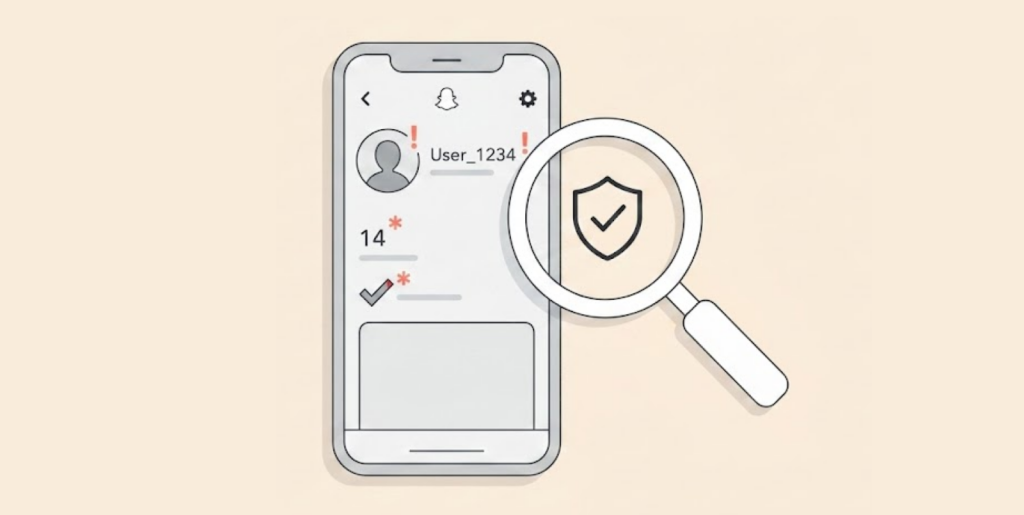
Scammers don’t always make themselves obvious. Sometimes you need to pay closer attention or dig a little. Here’s what you should check before you trust anyone new on Snapchat:
- Snap score: Real users often accumulate Snap scores by actually using the app consistently. A very low score on an account posing as a brand, celebrity, or influencer is a big red flag. Know that there’s no app as a Snapchat account checker, so if any app poses as it, know that it’s not legitimate. Beyond spotting fakes, adjusting your privacy settings is one of the best ways to limit your exposure to scammers.
- No Bitmoji: Most users set up a Bitmoji avatar to customize their account. If all you see is that blank icon, you’re probably dealing with a new account or a bot.
- Polished photos that look too perfect: Glossy, professional-looking photos should make you pause. Try running their pictures through Google Reverse Image Search; you might find the same images on random websites.
- Weird snap map locations: If someone claims they live in London, but all their snaps have location tags from a different country, something’s off.
- No verification badge: Real celebrities and brands have a yellow star to show they’re official. If someone brags about being famous but doesn’t have one, they’re faking it.
- Random/unsolicited DMs: If a stranger adds you and jumps straight into a conversation, especially to pitch something or ask for a favor, it’s probably a scam.
What to do if you got scammed on Snapchat
If someone has scammed you on Snapchat, act quickly. The list below is in order of priority, and every minute that an account or financial account has been compromised is crucial.
1. Take screenshots first
Before you block anyone, get proof of the whole conversation; every message, username, profile, all of it. You’ll need this for Snapchat support, your bank, or even the police.
2. Now block and report the scammer
In the chat, press and hold their username, tap “More,” then “Report,” and pick your reason. After that, block them everywhere they reach you.
3. Change your Snapchat password quickly
Make the new password strong and entirely different from the old one. Use something like a long string of random words, toss in numbers, special characters & letters. Not your dog’s name, not even your birth year. Plus, turn on your 2FA asap.
If you’ve been repeatedly targeted or simply want a fresh start, you might consider permanently deleting your account instead.
4. Run a malware scan
Did you click on any suspicious links? Do a malware scan now using reputable antivirus services like TotalAV or Norton 360.
5. Notify your bank
Report to your bank or payment services provider. If your money is removed from your account, call your bank or payment provider fast. Some payments can be reversed if you jump on them. Be clear, tell them it’s fraud.
6. Report everything to the authorities
Report what happened to the right places:
- The FTC (ReportFraud.ftc.gov)
- The FBI’s Internet Crime Complaint Center (ic3.gov)
- Shared your personal info with a scammer? Report it at IdentityTheft.gov
7. Lock your settings
Lock down your privacy settings on Snapchat. Decide who can contact you, watch your stories, or see your location.
8. Monitor your bank balance
And last but not least, monitor your bank accounts and credit cards for the next few days onwards. Setting up alerts for your bank accounts would help keep track of all your financial activity, so if anything new happens, you’d notice it early.
How to protect yourself from Snapchat scams
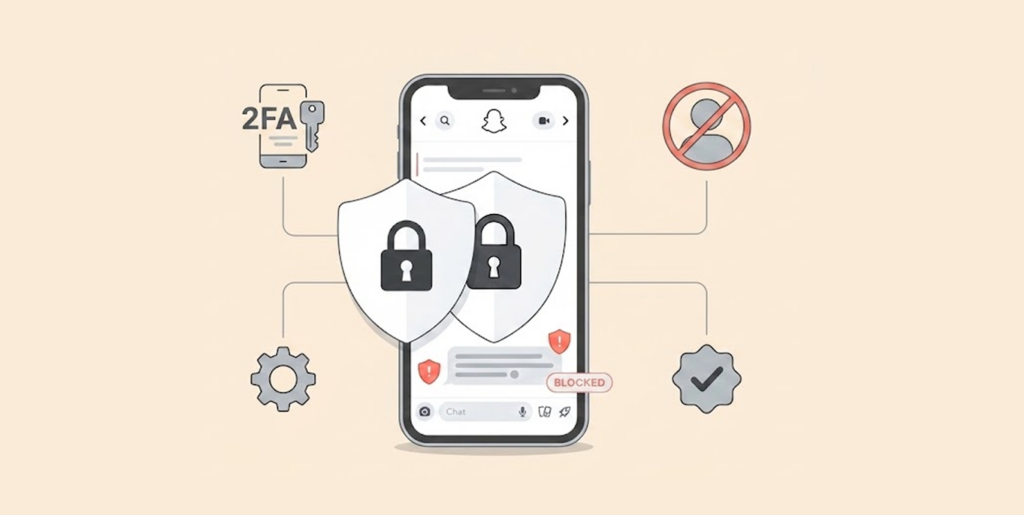
As we know, preventing problems is much easier than fixing the mess after it occurs. So here are some things you can do to avoid scams:
Account security
- If you’re still using your birthday or something like Password123 as your password, now is the best time to change that. Go for something nobody can figure out easily, like 16 characters, random numbers, symbols, uppercase, lowercase, etc. Just don’t recycle passwords.
- Also, turn on two-factor authentication. And don’t trust those SMS codes; it’s way too easy to hack these days. Grab an app like Google Authenticator; it’s way more secure.
- And every once in a while, check your account settings; find the part called Session Management. See any sketchy devices or locations? Log them out ASAP.
- The push for stronger account security comes as social platforms like Snapchat navigate complex privacy battles, including the ongoing feud between Facebook and Apple over tracking transparency.
Privacy settings
- Change “Who Can Contact Me” to Friends Only. That way, random people can’t message you.
- Enable Ghost Mode on Snap Map.
- Turn off “Show me in Quick Add” to prevent strangers from finding your Snapchat account.
- Save any sensitive pictures into My Eyes Only. Any pictures stored in that folder are secured with a password, and if anyone hacks your Snapchat account, they won’t be able to view what’s in the folder.
- When creating a Snapchat story, make it visible to either only your friends or to only a few individuals you trust.
Behavioral habits
- Never give out any verification codes to anyone, even if they say that they’re your friend or Snapchat Support.
- Always preview an external link before you actually click on it; the ability to preview links is available to Snapchat users for a reason.
- Don’t link your Snapchat account to just any app from random sources; some are just there to steal your login info.
- Personal details (phone number, address, or anything about your finances) should never be revealed in Snapchat chats.
- And if a stranger suddenly sends you a big payment, don’t touch it for at least a month. Let any suspicion clear before you do anything.
Catfishing vs. Romance scams: What’s the difference?
Romance scams want your money; that’s their main goal. But catfishing goes beyond that. Here, someone pretends to be another person to form a relationship; sometimes it’s not just to collect money.
Some catfishers are just bored people looking for entertainment by messing with others, or people who love playing mind games and manipulating others. The two often overlap; catfishing is usually the foundation on which most romance and sextortion scams are built.
Conclusion
Most Snapchat scams always follow the same playbook: they pressure you to act quickly, play on your emotions, and then ask for cash or sensitive info. If you know those warning signs, you’re already way ahead.
So, lock down your privacy settings. Don’t hand out verification codes, ever. If anyone on Snapchat asks you to send money, double-check by contacting them via another channel to know if it’s not a scammer. And if you feel something’s not adding up? Trust your gut; you might be on to a scam.
FAQs
Users often share personal details on Snapchat, such as their full name, date of birth, photos, email address, location, and sometimes even phone numbers. Scammers can misuse this information to make purchases, open accounts in your name, or impersonate you to scam others. If you think someone has stolen your information, place a fraud alert with Experian, Equifax, or TransUnion.
There are mostly scams. Snapchat never sends random texts out of the blue. If it isn’t from an official @snapchat.com email or you didn’t try logging in yourself, it’s someone fishing. Delete it, don’t tap anything.
Open the chat, hold on their name, then hit “More” (yeah, the three dots) and tap “Report.” Or you can go to their profile and look for “Manage Friendship” to report there. Have they already blocked you? Go to Snapchat Support and report. Taking screenshots of your conversations before anything else will ensure you have a bit of evidence when the chats disappear.
No. There’s no dedicated feature for checking if an account is real. But you can do: check their Snap score. If a so-called influencer or top brand has a low score of like 12, they’re probably a scammer. Check if their profile has a customized Bitmoji, or you can put their profile photo on Google Reverse Image Search. If the same face is on a stock photo website or random profiles elsewhere, you’ve got yourself a faker.
Scammers keep leveling up. Lately, it’s all about AI-powered impersonation (like deepfake videos for catfishing and romance scams). There’s even crypto pump-and-dump schemes now promoted via Snapchat Stories. It’s still the same old “pretend to be someone you trust, ask for money or info,” they’re just using fancier tools these days.
Don’t pay them any money, no matter what. That just puts a bigger target on your back. Block them. You can also report them on Snapchat. Or you reach out to law enforcement or even the FBI’s Internet Crime Complaint Center. Are explicit images of a minor involved? Report to NCMEC CyberTipline – they’ll help you handle it.
There’s more privacy now than before, 13 to 17-year-olds get better defaults, and under-16s can’t make public profiles. They’ve even got this Family Center for parents. Still, teens are huge targets for scams, sextortion, and all-around weirdos.