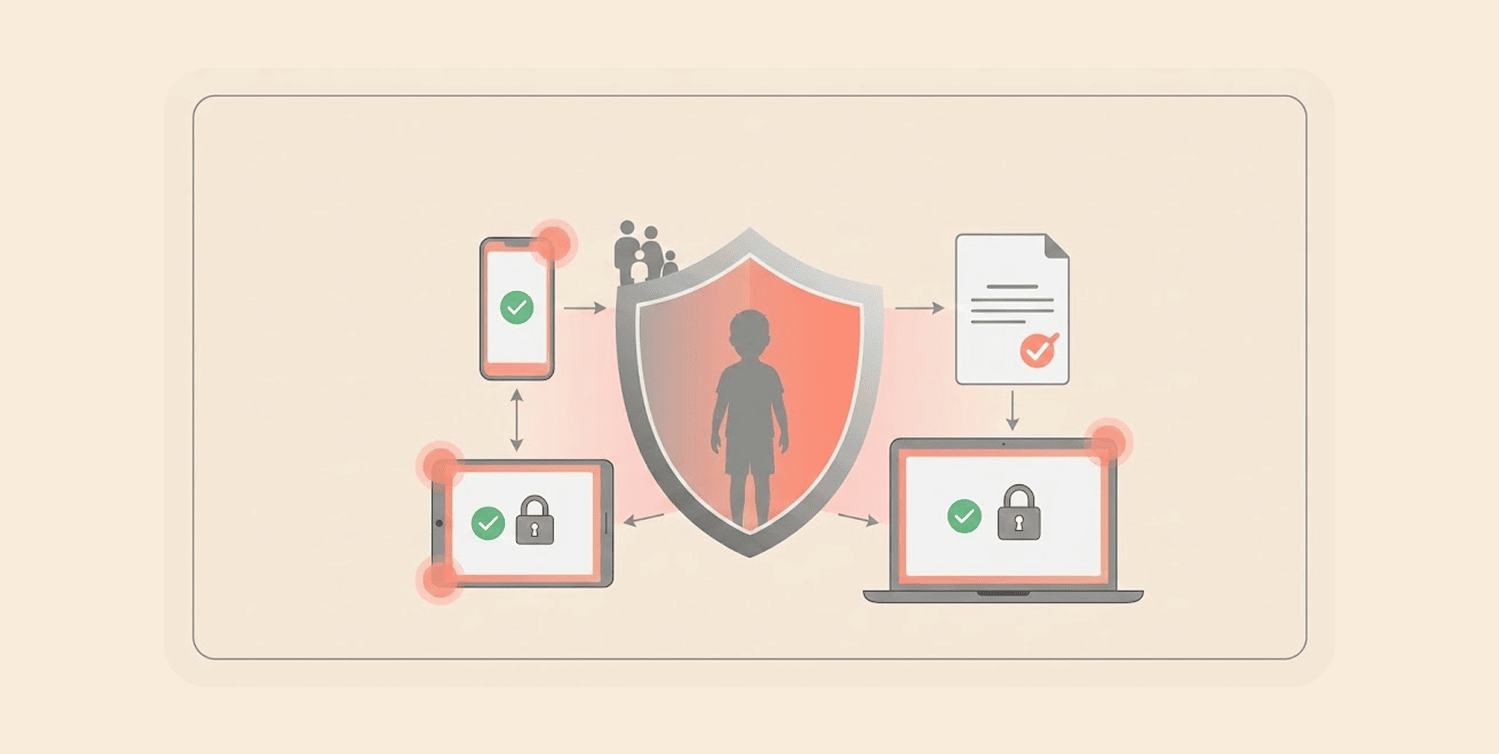
The United States House of Representatives has approved an extensive online safety bill. Those supporting this legislation argue that it’ll help to protect children better. But privacy advocates worry that it will change how millions of US residents use the internet.
The KIDS (Kids Internet and Digital Safety) Act received a bipartisan vote of 267-117 in the House of Reps. It comprises at least a dozen bills covering children’s online safety, age verification, AI, messaging apps, and app store requirements.
The authors of this bill believe that it equips parents with adequate means to protect their children. However, digital rights organizations have concerns that its consequences might reach beyond the intention.
It could warrant nearly everyone online to go through age checks, and also create new risks for private communications.
A broad package focused on child safety
The KIDS Act comprises an improved version of the Kids Online Safety Act (KOSA). This act has been on the debate floor in Congress for a number of years. Based on the revised bill, online services must take reasonable steps to avoid any foreseeable harms against children. Additionally, it suggests they add better privacy controls for younger users and parental features.
Not only does the proposed bill include improvements for the KOSA, but it also contains other proposals. Such proposals include those concerning age verification, AI chatbots that kids use, app store obligations, and online privacy protection.
The bill has two sponsors in the House, Republican Representative Brett Guthrie, from Kentucky, and Democratic Representative Frank Pallone Jr., from New Jersey. Such a bipartisan effort reflects the growing concern in Washington about how social media and negative online materials impact youth mental health.
According to supporters, the idea behind this bill is quite straightforward. They want online companies to build products that are safer for children instead of placing that burden on families. Guthrie called the bill “an important milestone, not a finish line” in the effort to protect kids online.
Sponsors reject claims of mandatory age checks
One of the biggest debates centers on age verification. The legislators behind the bill claim the act does not impose on firms the duty of ensuring age verification of all users. The firms will be able to pick the best way to meet the requirements of the law.
This issue has been central to the public discourse on the bill as critics have predicted wide-scale identity checks. The proponents claim those are just misunderstandings of the bill, as it actually gives companies a choice.
Privacy organizations have a different perspective
The Electronic Frontier Foundation and several other organizations devoted to digital rights protection believe the reality will be quite different. According to the EFF, the bill imposes certain requirements that’ll prompt businesses to ascertain whether or not users are adults or minors. Part of the provisions states that online services are liable if they “should have known” that the user is underage.
In such circumstances, it seems very likely that there will be an incentive for verifying the ages of all users. For this reason, privacy activists believe that many websites and applications will opt for de facto universal age verification rather than face any legal actions.
There is an additional fear among privacy groups that, in verifying the ages of so many people, more data will have to be collected by corporations. This will lead to additional databases being created, which might be more vulnerable to data breaches or identity theft. There is also a fear that the practice of anonymous browsing on the internet will become impossible.
Encryption concerns remain
There’s also another set of bills in the spotlight, this time focused on encrypted messaging platforms. The laws don’t ban end-to-end encryption outright, but critics worry they’ll push companies to make their apps less private. This has sparked some real debate about user privacy and security.
They argue that companies will be obliged to monitor and prevent harmful messages involving children, and may find it difficult to do so without the ability to read encrypted messages. As a result, privacy advocates fear companies could eventually reduce or change encryption features to lower legal risk.
The tension between corporate policies and security is not limited to legislation. Microsoft recently locked out a WireGuard developer in a verification sweep, blocking critical security updates and raising questions about the company’s approach to developer verification.
Supporters reject that interpretation. While the bill does not oblige companies to disable encryption or make their messaging insecure, the matter has turned out to be one of the hottest topics of the discussion.
AI and App Stores also face new rules
The bill introduces additional requirements for AI chatbots, intended for use by children. The idea is that companies designing AI should introduce additional security measures when children communicate through these tools.
In addition, there are new obligations for app stores. These provisions aim to give greater control over the online activities of children by parents and improve transparency on digital services.
The Senate is the next hurdle
Although the House has approved the KIDS Act, it is not yet law. The US Senate has already passed its version of the bill; however, differences still exist in regard to the approach that is proposed by each chamber.
One of the key issues is the absence of a “duty of care” provision from the House version. Senator Maria Cantwell, along with Senator Richard Blumenthal, has made statements expressing their interest in establishing stricter regulations.
All that remains is for lawmakers to complete negotiations and send the final version of the bill to President Donald Trump to sign it into law. Depending on the outcome, the bill can influence the online world for many years to come.
On one hand, the passage of the KIDS Act is seen by its supporters as an overdue step to ensure the internet safety of children. On the other hand, the problem for the opponents of the bill is that ensuring safety should not lead to the violation of the right to privacy, freedom of speech, or security of communications.
